
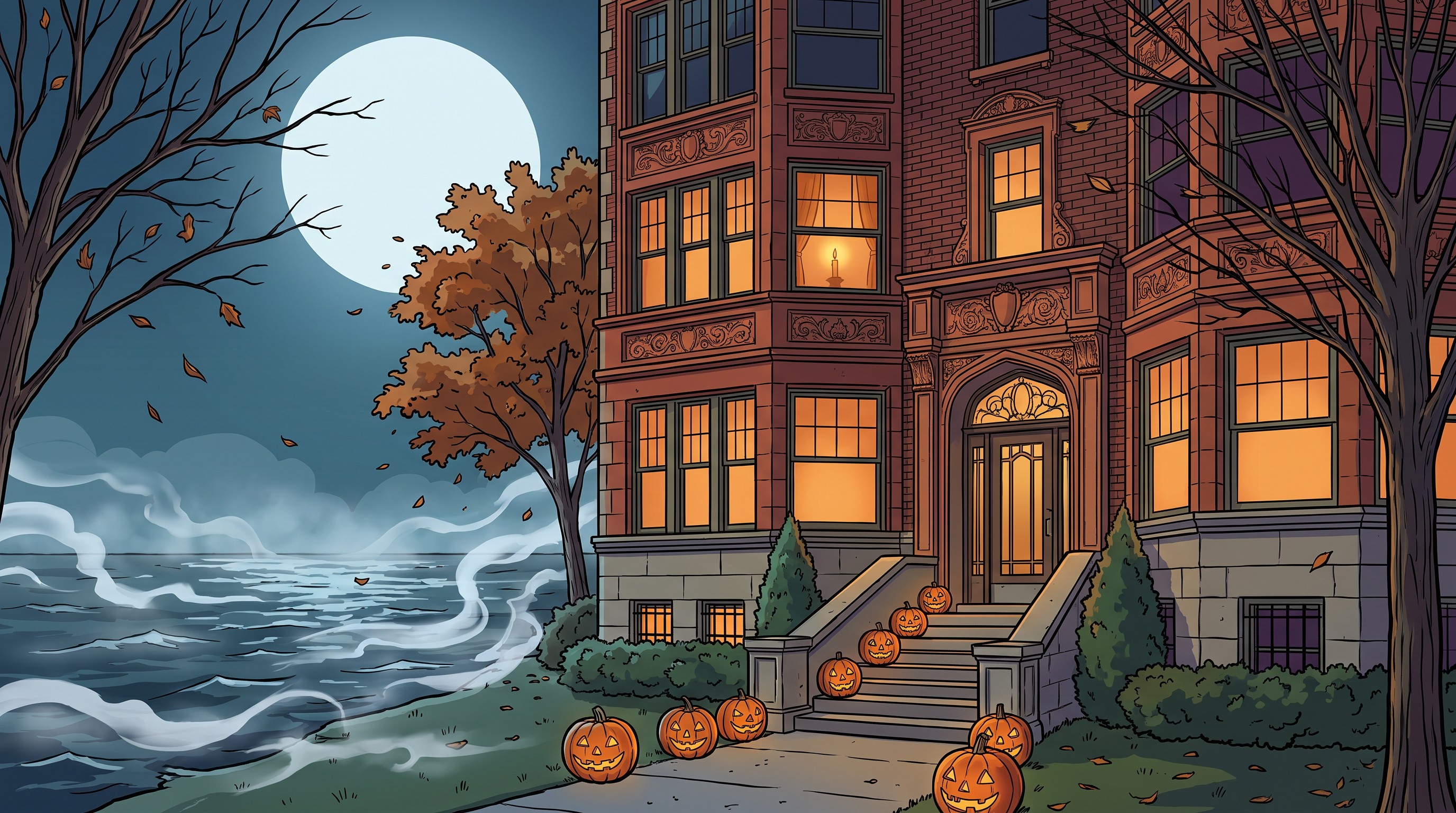
 Illustration
Halloween
Checked In for Good: Chicago's Storied Hotels and Haunted Homes
From Englewood's infamous “castle” to the apartment hotels where Chicago learned to live together, a Halloween look at residential buildings with a past.
Every apartment building has stories. Residents come and go, and some, according to the ghost stories, never quite leave.
For Halloween, we looked at a few Chicago hotels and residential buildings whose pasts are bigger than their floor plans. Fact and legend are clearly labeled.
The “castle” was a mixed-use building
One of the most infamous buildings in Chicago history was, on paper, a familiar investment: shops on the ground floor, small apartments above.
H.H. Holmes, born Herman Webster Mudgett, built it at 63rd and Wallace in Englewood between 1889 and 1891, across the street from his pharmacy. It was called the World’s Fair Hotel, after the 1893 Columbian Exposition in Jackson Park. History remembers it as the “Murder Castle.”
Holmes was arrested in 1894 and hanged in Philadelphia on May 7, 1896. He confessed to 27 murders, though historians say that number is questionable, and that many of the building’s most lurid features, from trapdoors to a basement crematorium, likely came from embellished 1890s newspaper stories.
The building was gutted by fire in 1895, partly rebuilt, and demolished in 1938. A New Deal–era U.S. Post Office stands on the site today. According to local ghost-tour guides, people still report strange sounds and shadowy figures in its basement.
The takeaway for owners: the real story of a building lives in its records, not its rumors.
Hull-House and the “Devil Baby”
On Halsted Street, Hull-House began as a summer estate built by Charles Hull in 1856. In 1889, Jane Addams opened it as a social settlement, where she and a community of residents lived and worked among their neighbors. Today the house is a museum run by the University of Illinois Chicago.
In 1913, a rumor spread that a “Devil Baby” was being kept inside. The story was baseless, but it stuck.
According to local lore, the house has other visitors, too. Tales mention the ghost of Mrs. Hull, and visitors and tour guides have reported flickering lights and things moving after dark. More than a century and a half after it was built, Hull-House is still one of the most talked-about homes in the city.
A gambler’s mansion on South Michigan
At 2944 S. Michigan Ave. stands Kent House, one of the few mansions left on that stretch of the avenue. Burnham & Root designed it in 1883 for Sidney A. Kent, a founder of the Chicago Union Stock Yard Company. Its big windows and sculpted masonry hint at the firm’s later work on the Rookery and the Monadnock.
The house’s second owner supplied the legend: John “Bet A Million” Gates, known for his gambling and for the fortune he made in barbed wire. Kent House became a Chicago Landmark in 1987, a reminder that South Side blocks hold some of the city’s finest residential architecture.
Apartment hotels: Chicago’s original flexible housing
Long before “extended stay” became a buzzword, Chicago had apartment hotels and residential hotels. A couple of them have stories worth telling.
The Flamingo. In Hyde Park, the building at 5500–5520 S. Shore Drive was built in 1927 as an apartment hotel: 16 stories, 144 apartments and 16 hotel rooms, with an outdoor pool and bathhouse on the lakefront. Architect William C. Reichert dressed it in red brick and terra cotta. Also known as the Flamingo Apartment Hotel, it was added to the National Register of Historic Places in 1986 as the Flamingo-on-the-Lake Apartments, and it sits beside the Promontory Apartments, designed by Mies van der Rohe.
The Wells-Grand. On the Near North Side, the Wells-Grand Hotel at 533 N. Wells St. was a men’s hotel run by the parents of Studs Terkel, the late Chicago author and broadcaster. Terkel grew up there and worked the front desk as a young man. Hard to imagine a better place to learn how people talk.
Neither building needs a ghost to be memorable. They’re reminders that service-rich, flexible rental housing isn’t a new idea. Chicago has been doing it since at least the 1920s.
Buildings that last are the ones people keep finding new reasons to live in. A story means a place has been lived in, loved and reused, and that’s real value. Own an apartment building with a past, or a few unexplained creaks? Tell us about it at investment@kwcommercial.com.